Bloody Mary rituals exploit the Troxler effect
Fixate on a dim mirror and the Troxler effect erases facial edges, letting folklore and fear populate the glass with ghosts.
Share this fact
🪞 The Bloody Mary dare is a Troxler experiment in costume
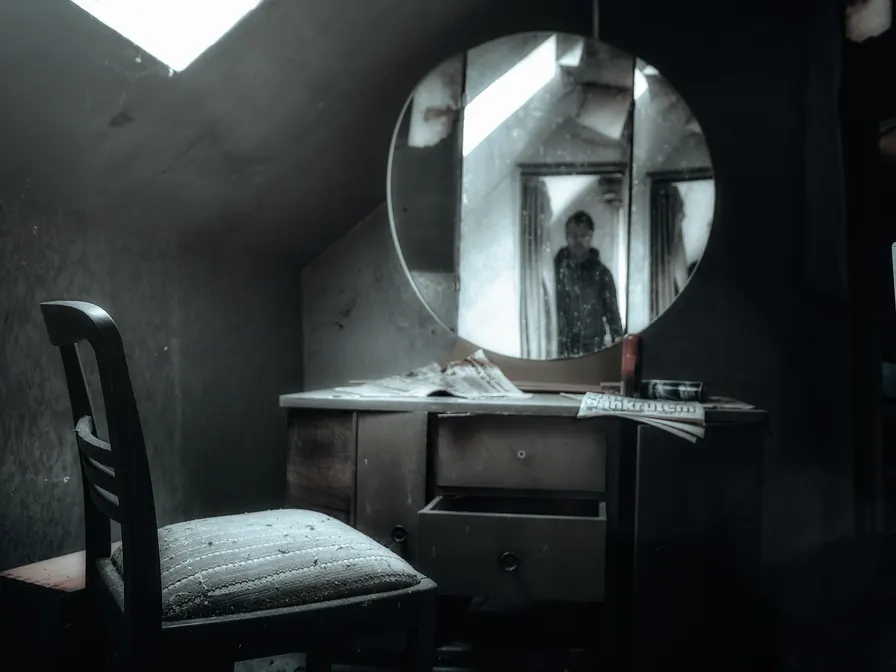
Stare at any point long enough and your peripheral neurons stop reporting back. Early opticians cataloged the quirk in 1804, but sleepovers wrapped it in candles, chanting, and a forbidden name: Bloody Mary. Set the lights to a dull glow, lock your gaze on your pupils, and within 20–30 seconds the Troxler effect fades your facial edges. Your brain, primed by whispered legends, fills that sensory vacuum with whatever horror script your friends supplied.
1. What the Troxler effect actually does
- Neural adaptation: Photoreceptors and visual cortex neurons tune out unchanging stimuli. Fix your gaze on your right eye and your cheeks, hairline, and background begin dissolving.
- Color desaturation: Rod cells dominate in low light, so reds wash away first. The absence of hue reads as corpse-pale skin.
- Contrast filling: Once your brain loses real edges it invents new ones, often darker than reality—hence dripping shadows or “blood”.
- Expectation bias: Chant “Bloody Mary” three times, and your predictive coding machinery hunts for a queen, a witch, or a vengeful ghost.
Add spinning (vestibular confusion) or candle smoke (tearing eyes) and the illusion escalates. It is essentially a DIY neurology demo with better marketing.
2. Ritual timeline
| Era | Twist | Why it spread |
|---|---|---|
| Victorian parlors | Fortune-telling mirrors promised glimpses of future husbands. | Courtship games disguised as etiquette lessons. |
| 1970s teen magazines | Candles, chanting, spinning added. | Pop culture fascination with witchcraft + slumber-party dares. |
| 1990s chain emails | Threats (“Ignore this and she’ll visit tonight”). | Viral fear loops before social media. |
| Modern TikTok challenges | LED strips, smart mirrors, AR filters. | Jump-scare content farms engagement. |
| Escape rooms | Smart glass + surround audio create apparitions. | Monetized nostalgia for analog scares. |
Each generation layers tech on top of the same optical hack, proving how portable the illusion is.
3. Why the brain loves haunted mirrors
- Threat rehearsal: Your amygdala treats ambiguous stimuli as danger until proven otherwise.
- Social bonding: Surviving the dare together cements friendships—Oxytocin spikes follow shared scares.
- Agency test: Tweens crave control; summoning a legend inside a bathroom feels like rule-breaking with minimal risk.
- Embodied storytelling: You are both actor and audience, reinforcing the legend through lived sensation.
- Memory stickiness: Adrenaline during low light etches episodes more vividly, ensuring the myth survives.
4. Build a science-backed ritual (and stay safe)
- Lighting: Use a single warm bulb or candle behind you to maximize peripheral fading. Avoid open flames near hairspray or loose sleeves.
- Focus point: Place a sticky dot between your eyebrows. Stare there without blinking for 30 seconds, then glance away and notice how the illusion collapses.
- Breathing cue: Inhale four counts, exhale six to keep heart rate down. Fear needs oxygen debt—do not give it one.
- Mantra: Whisper “Troxler is happening” each time edges melt. Naming the effect steals its mystique.
- Exit plan: Flip the main light or splash water. Rapid sensory contrast resets the visual system.
Quick checklist
Timer set • Candle behind you • Sticky dot focus • Breath cue • Light switch mapped
5. Myth vs. fact
| Myth | Fact |
|---|---|
| Mary will claw you if you stop chanting. | Nothing crosses the mirror; your own fingernails might scratch if you flail. |
| Seeing blood means a curse. | Dilated capillaries and tear streaks look red in candlelight—basic optics. |
| Spinning 13 times guarantees an apparition. | Dizziness plus Troxler equals smear lines, not spirits. |
| Breaking the mirror frees her. | Broken glass frees a mess and possible ER visit. |
6. FAQ
Why do some people see animals instead of Mary? Troxler fading does not discriminate; your brain pulls imagery from whatever scares you most.
Can Troxler effect trigger panic attacks? Yes, especially if you hyperventilate. Grounding breath work keeps episodes tolerable.
Does blinking stop the illusion? Blinking refreshes the scene, so the ghost vanishes—proof it was perception, not paranormal activity.
Is there a safe age to try this? Pre-teens should have an adult nearby. Younger kids can confuse the effect with genuine danger.
Could augmented-reality mirrors make it worse? Absolutely. Layering AR overlays exploits the same predictive coding and can be used intentionally for immersive theater—or misinformation.
Bloody Mary survives because it weaponizes a real cognitive quirk. Once you understand Troxler fading, you can run the ritual as a sensory experiment, document the results, and leave the bathroom with bragging rights instead of broken glass.